Small landlords minimize conflicts by setting clear written expectations from day one and documenting every interaction. They use precise leases, posted rules, and consistent enforcement. Communications are empathetic, structured, and confirmed in writing. Payment risks trigger early outreach, defined plans, and uniform criteria. Maintenance is triaged by urgency with transparent timelines and photo-verified closure. Noise disputes are logged, corroborated, and addressed with practical fixes. Mediation is used with written summaries and enforceable terms. Systematized templates and scripts reduce risk and improve outcomes more follows.
Key Takeaways
- Set clear expectations in writing from day one; review and initial key lease clauses to prevent misunderstandings.
- Document everything: time-stamp communications, store photos, inspection checklists, maintenance logs, and signed agreements.
- Use empathetic, active listening; paraphrase concerns, keep neutral language, and confirm next steps in writing.
- Triage maintenance issues by urgency with target timelines; communicate scope, access windows, and verify completion with photos.
- Standardize workflows and templates for notices, payment plans, and mediation; apply criteria consistently to avoid bias and escalation.
Table of Contents
Set Clear Expectations From Day One
From day one, a small landlord must define terms, roles, and boundaries in writing to prevent disputes. A clear process sets tenant expectations and establishes shared norms that support a respectful community. Use precise lease agreements that specify rent due dates, payment methods, late fees, occupancy limits, maintenance responsibilities, quiet hours, pet policies, and parking rules. State how notices are delivered, how requests are submitted, and response timeframes. Establish escalation steps for unresolved issues and reference governing laws.
Before move-in, review key clauses with applicants, confirm understanding, and obtain initials on critical terms. Provide a concise handbook mirroring the lease. Post essential rules in common areas. Maintain consistent enforcement across units. Train any helpers to apply policies uniformly. Clarity early reduces risk, fosters trust, and sustains cohesion.
Document Everything to Protect Both Sides
Clear expectations only work when supported by a verifiable paper trail. A small landlord minimizes disputes by standardizing tenant documentation from application to move-out. Every policy, fee, and deadline belongs in signed lease agreements and addenda. Time-stamp all communications, retain photos, inspection checklists, and receipts. Store documents in a structured system with consistent file names and backups.
Procedurally, log maintenance requests, response times, and resolutions. Use written notices for rule violations and acknowledgments for payment plans or waivers. Confirm verbal discussions in writing. Record rent ledgers monthly, noting charges, credits, and balances. Collect signatures digitally for authenticity and audit trails.
This approach protects both sides, builds trust in the community, and reduces legal exposure by demonstrating fairness, consistency, and evidence-driven decision-making.
Communicate With Empathy and Active Listening
How does a small landlord reduce conflict before it escalates? Start with a structured communication plan that centers residents’ dignity. Schedule conversations, state the purpose, and invite perspectives. Use empathy exercises beforehand briefly imagine the resident’s constraints, list their likely goals, and separate behavior from character. This primes consistency and fairness.
Apply active listening techniques: ask one clear question at a time, paraphrase key points, and confirm understanding before responding. Note facts and feelings distinctly. Maintain neutral language, avoid assumptions, and summarize agreed next steps in writing. Set boundaries: time limits, agenda adherence, and channels for follow-up.
Risk management requires awareness of bias. Track interactions, review patterns, and seek peer feedback to calibrate tone. Consistent, empathetic communication sustains trust and lowers dispute frequency.
De-escalate Tense Conversations in Real Time
To prevent escalation, the landlord signals Active Listening with concise acknowledgments, open body posture, and brief paraphrases of the tenant’s key concerns. They standardize Neutral Language and Tone avoiding blame, inflammatory adjectives, and sarcasm while speaking slowly and at a measured volume. If voices rise or tension spikes, they pause, reset to neutral phrasing, and restate the shared objective before proceeding.
Active Listening Cues
Although emotions may be running high, effective de-escalation begins with observable active listening cues that signal safety and control. A small landlord can model active engagement through steady posture, patient timing, and reflective feedback that verifies understanding without promise or blame. The objective is to lower arousal, keep facts accessible, and invite shared problem-solving.
Key cues should be deployed consistently:
| Cue | Purpose | Risk if Omitted |
| Open stance | Signals availability | Escalation from perceived defensiveness |
| Measured nods | Reinforces turn-taking | Interruptions and talking over |
| Brief summaries | Confirms facts | Misinterpretation of requests |
| Clarifying questions | Surfaces specifics | Circular argument loops |
| Visible note-taking | Shows accountability | Claims of being ignored |
Procedurally, they listen first, summarize second, and only then propose next steps. This builds trust and preserves safety.
Neutral Language and Tone
Procedure: define the issue, separate facts from interpretations, offer choices, summarize next steps, and confirm timing. Risk controls include avoiding absolutes, refraining from sarcasm, and documenting agreements in real time. Belonging is reinforced by inclusive language “we,” “our agreement,” “shared standards” which signals dignity, fairness, and predictable boundaries for everyone.

Address Rent and Payment Issues Proactively
Effective prevention starts with clear rent policies that specify amounts, due dates, late fees, and documentation requirements. When payment risk indicators appear, the landlord initiates early communication steps: confirm facts, issue written notices, and schedule a solution-focused meeting. If hardship is verified, implement flexible payment plans with defined milestones, default triggers, and follow-up checkpoints to limit exposure.
Clear Rent Policies
When rent expectations are unambiguous from the outset, payment disputes diminish and enforcement becomes simpler. Clear rent policies belong in writing, embedded in lease agreements and supported by consistent practice. State the rent amount, due date, grace period, acceptable payment methods, and the precise late-fee schedule. Define the sequence for missed payments, including courtesy periods, notices, and escalation steps compliant with local law. Specify criteria and timelines for a rent increase, including required notice and caps where regulated. Document prorations, returned-payment fees, and allocation order (oldest balances first). Standardize hardship accommodations to avoid favoritism and discrimination risks. Keep records of all policy acknowledgments. Review policies annually for legal changes and market conditions, then update forms uniformly. Consistency builds trust while protecting cash flow.
Early Communication Steps
With rent policies documented and delivered, proactive communication becomes the first line of defense against arrears. The landlord establishes a routine cadence: a friendly reminder seven days before due date, a confirmation notice on due date, and a check-in at 48 hours late. Each touchpoint is concise, consistent, and archived.
During tenant onboarding, the landlord sets expectations for response times, preferred channels, and escalation thresholds. They invite open dialogue by offering a clear contact path and office hours, signaling that questions are welcome before problems harden. When a payment risk appears job change, bank error, pattern of partials the landlord requests facts, dates, and documentation within a defined window. They restate policy, outline next steps, and confirm understanding. Timely, respectful engagement preserves trust and reduces dispute exposure.
Flexible Payment Plans
Although rent is a fixed obligation, a landlord can mitigate default risk by deploying structured, time-bound payment plans before arrears escalate. The approach begins with a written policy outlining eligibility, documentation required, and acceptable payment options. A standard template should specify installment amounts, due dates, late-fee handling, and default triggers, ensuring tenant flexibility without compromising predictability.
Next, confirm the tenant’s income cadence and align installments accordingly. Require partial payment upfront to demonstrate commitment, and use automated reminders. Document every agreement with signatures, including a clause reverting to full balance if deadlines are missed.
Assess legal constraints, fair housing risks, and accounting impacts before implementation. Apply criteria consistently across households to maintain trust and belonging. Review plans monthly, adjust as circumstances change, and close with a paid-in-full acknowledgment.
Resolve Repair and Maintenance Disputes Efficiently
Set clear protocols to triage, document, and resolve repair requests before they escalate into disputes. A shared standard keeps everyone aligned on repair timelines and maintenance responsibilities, reducing ambiguity and legal exposure. Use a single intake channel, time-stamp submissions, and acknowledge receipt promptly to create trust and an auditable trail.
Create one clear, auditable repair process to reduce ambiguity, align expectations, and prevent disputes.
- Intake and triage: classify urgency (life-safety, habitability, routine), assign target repair timelines, and confirm responsibility per lease and statute.
- Transparent communication: provide written scope, access windows, vendor identity, and contingency steps if delays occur.
- Verification and closure: require photo or video confirmation from vendor and resident; record warranties and follow-up dates.
- Escalation pathway: define mediation triggers, rent abatement criteria for habitability failures, and emergency authorization limits.
Consistent execution fosters belonging, fairness, and predictable outcomes.
Manage Noise and Neighbor Conflicts Fairly
Most noise and neighbor conflicts can be contained early by formalizing expectations, documentation, and proportionate enforcement. Clear lease clauses on quiet hours, prohibited devices, and consequences set shared norms and support noise reduction. He posts building-wide guidelines, distributes them at move-in, and logs complaints with time, source, and impact. He verifies patterns with objective checks decibel apps, hallway walkthroughs, and corroborating reports before issuing graduated notices. To preserve neighbor relations, he communicates outcomes to affected parties without disclosing private details, and offers practical fixes: door closers, felt pads, rugs, and staggered move times. He documents each step, measures recurrence, and resets expectations promptly.
| Situation | First Action | Next Step |
| Late-night music | Courtesy notice | Written warning |
| Barking dog | Verify duration | Pet addendum |
| Footfall noise | Rug requirement | Unit inspection |
| Repeated parties | Lease citation | Fine per policy |
| Appliance hum | Check equipment | Repair order |
Use Mediation and Third-Party Resources Wisely
When internal efforts stall, a landlord should pivot to structured mediation and vetted third-party resources to contain risk, cost, and escalation. This phase requires disciplined intake, clear goals, and neutrality. Effective mediation techniques center on interests, verifiable facts, and durable agreements that all parties can own.
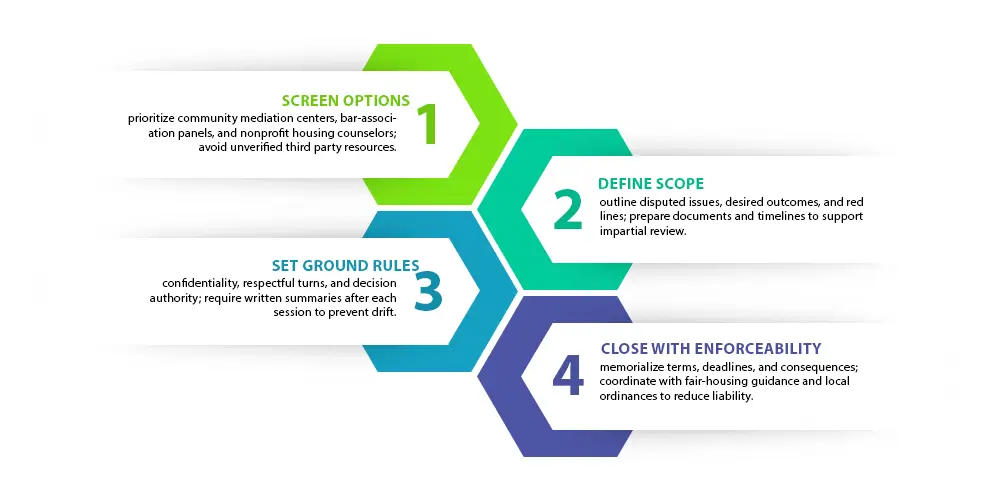
Applied correctly, outside help preserves relationships and stabilizes operations.
Create Repeatable Systems and Scripts for Consistency
A disciplined landlord operation relies on standardized workflows and plain-language scripts to remove guesswork, reduce bias, and control risk. A systematic approach creates uniform steps for intake, notice, follow-up, and escalation, so teams act consistently and residents experience fairness. Communication templates anchor tone, legal references, and response timelines, minimizing drift and emotional escalation.
Key components can be defined, tracked, and trained:
| Scenario | Script Objective | Next Action |
| Late rent | State facts, options, deadlines | Document call; send notice |
| Noise complaint | Verify details; set expectations | Log incident; schedule check-in |
| Repair delay | Acknowledge; provide timeframe | Dispatch vendor; confirm window |
| Lease breach | Cite clause; outline cure path | Issue cure notice; calendar review |
Regular audits retire ambiguous language, align with statutes, and reinforce community standards.
Frequently Asked Questions
How Should Landlords Handle Conflicts Involving Tenants With Disabilities or Accommodations?
They should promptly assess needs, document requests, and provide reasonable accommodations. They use effective communication, verify medical necessity only as permitted, involve neutral mediation, set timelines, train staff, and monitor compliance minimizing legal risk while fostering dignity, inclusion, and stable community relationships.
What Legal Pitfalls Should Small Landlords Avoid During Conflict Resolution?
They should avoid discriminatory actions, improper notices, and self-help tactics. Adhere to eviction procedures, document communications, and honor lease agreements. Respect privacy laws, security deposit rules, and retaliation prohibitions. Seek counsel before escalation, ensuring consistent, fair practices that protect community trust and legal compliance.
How Do Cultural Differences Impact Conflict Resolution Approaches With Tenants?
Cultural differences shape expectations, requiring cultural sensitivity and calibrated communication styles. Practitioners should assess norms, avoid assumptions, use interpreters when needed, document agreements, and confirm understanding. Procedurally, they establish shared ground rules, validate identities, and escalate carefully, minimizing misinterpretation risk while fostering inclusive, trust-centered tenant relationships.
When Should a Landlord Involve Insurance in a Tenant Dispute?
A landlord should involve insurance when tenant disputes involve property damage, liability exposure, injuries, potential litigation, or police reports. They document events promptly, notify the carrier, preserve evidence, avoid admissions, follow policy timelines, and coordinate repairs while supporting community stability and fairness.
How Can Technology Tools Streamline Tracking and Resolving Tenant Conflicts?
Technology tools streamline tenant conflicts by centralizing tenant communication, automating documentation, and standardizing dispute management workflows. They enable timestamped records, escalation rules, and analytics, reducing ambiguity and risk while fostering transparent collaboration, shared expectations, and timely resolutions across teams and resident communities.
Conclusion
Effective conflict resolution for small landlords relies on disciplined procedures and early intervention. By setting expectations, documenting interactions, and applying empathetic yet firm communication, they reduce risk and protect relationships. Real-time de-escalation, proactive rent management, and streamlined repair workflows prevent escalation and liability. Fair handling of noise and neighbor issues, supported by mediation when necessary, closes gaps. Finally, standardized scripts, checklists, and audit trails guarantee consistency, compliance, and defensibility creating a repeatable framework that minimizes disputes and preserves operational stability.