
EICR Code for No RCD in Bathroom: On an EICR, no 30 mA RCD protecting bathroom circuits is typically coded C2 (potentially dangerous) under BS 7671 Section 701. Wet conditions lower body resistance, so RCDs are essential to achieve required disconnection times and reduce shock risk. We verify supply characteristics, bonding, IP/zones, and test Zs, R1+R2, insulation, and polarity. Fixes include RCBOs/dual‑RCD boards or local 30 mA RCD spurs/sockets, ensuring ≤40 ms at 5x IΔn and proper labeling. We’ll outline risks, tests, and the quickest compliant upgrades next.
Key Takeaways
- Absence of 30 mA RCD protection for bathroom circuits typically warrants a C2 code on an EICR due to increased electric shock risk.
- BS 7671 Section 701 requires RCDs on all final circuits supplying or passing through bathroom zones, including lighting and fixed appliances.
- Risks include insulation failure energizing metal parts, moisture reducing body resistance, and loss of the last protective measure against indirect contact.
- Verify compliance via tests: Zs/disconnection times, R1+R2 continuity, insulation resistance, polarity, and bonding to 701.415.2.
- Fixes: install RCBOs or dual-RCD boards, or local 30 mA RCD FCUs/sockets; ensure ≤40 ms at 5×IΔn and update EICR to close C2.
Table of Contents
What an EICR Is and How Bathroom Circuits Are Assessed
Electrical compliance starts with the EICR an Electrical Installation Condition Report that evaluates whether an installation meets current BS 7671 requirements and is safe for continued use. In our EICR terminology overview, we explain observation coding, supply characteristics, and protective device details so you know what we’ve inspected and why. We reference applicable Electrical safety standards, verify earthing and bonding, and document limitations clearly.
When we assess bathroom circuits, we apply disciplined circuit assessment methods: identify zones, confirm IP ratings, inspect supplementary bonding where applicable, and verify disconnection times. We test continuity of CPCs, insulation resistance, and polarity, then confirm protective device characteristics and prospective fault currents. We review SELV/PELV segregation, check isolation and labeling, and examine enclosure integrity. Our risk-aware approach records non-compliances, assigns codes, and recommends targeted remedial actions.

Why Bathrooms Require RCD Protection Under BS 7671
Because bathrooms combine water, earthed metalwork, and confined spaces, BS 7671 mandates 30 mA RCD protection to reduce shock risk from indirect contact and equipment faults. We follow Section 701, which recognises reduced body resistance in wet conditions and the heightened probability of fault currents flowing through people to earth. For bathroom safety, residual current protection limits disconnection times to curb ventricular fibrillation risk, aligning with IEC shock curves and UK electrical standards.
RCDs also mitigate cumulative hazards from metallic pipework, supplementary bonding interfaces, and Class I appliances. They provide fault-current detection beyond overcurrent devices, which can’t respond to small but lethal leakage. As duty holders, we prioritise shock prevention, fire risk reduction from earth faults, and compliance, ensuring installations meet contemporary BS 7671 intent and tolerable risk criteria.
Which Circuits Serving Bathrooms Need RCDs
While scope varies by installation, BS 7671 requires 30 mA RCD protection for all final circuits that supply equipment in, or pass through, locations containing a bath or shower. We apply that to lighting, socket-outlet, shower, fan, and underfloor heating circuits, plus any towel rail or whirlpool pump. Even circuits merely passing through the bathroom zones require RCDs for bathroom circuit safety, per electrical installation guidelines and rcd compliance requirements.
| Circuit type | Typical devices | RCD note |
| Lighting | Luminaires, mirrors | 30 mA RCD if serving or passing through bathroom zones |
| Socket-outlet | Shaver, cleaners | All sockets require 30 mA RCD |
| Fixed appliances | Shower, UFH, fans, rails | 30 mA RCD, consider isolation and zones |
| Pass-through | Ring final, radial | RCD if cable routes traverse zones |
We verify disconnection times, cable routes, and protective devices align with BS 7671.
Understanding EICR Codes: C1, C2, C3, and FI
Having set out where RCD protection must exist in bathrooms, we now classify any shortfalls using EICR coding so reports are consistent and risk-led. Using precise EICR terminology helps us communicate risk and the urgency of corrective work that affects Bathroom safety and compliance with RCD installation requirements.
We classify bathroom RCD shortfalls using EICR codes to ensure consistent, risk-led reporting and remedial urgency.
- C1: Danger present now. Immediate risk of electric shock or fire; we must make safe at once and record urgent remedial action.
- C2: Potentially dangerous. A foreseeable fault could expose users to risk; prompt corrective work is required to remove the hazard.
- C3: Improvement recommended. Not unsafe, but enhancement to current standards often upgrading protection or labelling—will reduce risk.
- FI: Further Investigation. Evidence suggests an underlying defect; we need targeted testing or inspection before assigning a definitive code.
These codes guarantee consistent judgments and prioritised remediation.
When “No RCD” in a Bathroom Is Categorised as C2
Although not every legacy installation is automatically unsafe, we categorise “no RCD” in a bathroom as C2 when any circuit serving locations containing a bath or shower lacks 30 mA additional protection as required by BS 7671 (e.g., Regs 411.3.3 and 701.411.3.3). A C2 reflects a potentially dangerous situation: increased shock risk in zones where body resistance is low and simultaneous contact with earth is likely.
We apply Bathroom safety standards and Electrical compliance guidelines pragmatically: final circuits supplying shower units, lighting with metal parts, fans, or shaver points within zones demand ADS plus 30 mA RCD protection with suitable disconnection times. If protection’s absent, we record C2 and recommend urgent remedial action.
RCD installation options include RCBO upgrades, split-load consumer units, or stand-alone upstream RCDs, verifying Zs and selectivity.
When “No RCD” Might Be Noted as C3 Only
We’ve set out why “no RCD” in bathrooms often warrants C2; however, some legacy arrangements justify only a C3 (improvement recommended) where risk is demonstrably low and BS 7671 allows engineering judgement. We look for robust earthing, fault protection, and evidence that usage doesn’t introduce handheld Class I appliances. RCD alternatives may mitigate shock risk, but we document Compliance implications and clear Safety considerations.
- All circuits are protected by SELV or fixed Class II equipment, with sound supplementary bonding verified by testing.
- Luminaires and fans are double insulated; no socket-outlets or whirlpool equipment present on the circuit.
- Measured Zs values confirm automatic disconnection times with MCBs; enclosure integrity and insulation resistance are satisfactory.
- Protective bonding continuity is confirmed; no signs of alteration, damage, or moisture ingress affecting protective measures.
Special Locations and Zones: IP Ratings and RCD Implications
Because bathrooms are “special locations” under BS 7671 Section 701, zoning dictates both IP ratings and where 30 mA RCD protection is mandatory. We assess Zones 0, 1, and 2, plus outside zones, to guarantee bathroom safety and electrical compliance. In Zone 0 (inside the bath/shower), only SELV ≤12 V AC (30 V DC) with IPX7 equipment is permitted. Zone 1 requires IPX4 (IPX5 if water jets) and 30 mA RCD protection for circuits supplying luminaires, fans, and showers. Zone 2 extends 0.6 m beyond Zone 1; equipment must be IPX4 and RCD-protected.
Where metallic pipework or supplementary bonding apply, we verify protective measures align with installation standards. Shaver sockets, heated mirrors, and towel rails must be selected and located per zone ratings and RCD implications.
Typical Risks: Electric Shock, Moisture, and Fault Scenarios
Even in seemingly dry areas, bathrooms present heightened shock risk due to low body resistance, conductive moisture films, and simultaneous contact with earth via taps and pipework. Without RCD protection, fault currents can persist long enough to be lethal. We focus on electric shock prevention, moisture management, and credible fault detection strategies that align with wiring regulations for special locations.
- Wet surfaces lower skin impedance, so touch voltage from a faulted luminaire or mirror heater can exceed safe disconnection limits.
- Condensation bridges live parts to earthed metalwork; inadequate IP ratings exacerbate tracking and corrosion.
- Aging fans, towel rails, or pull-cord switches can develop insulation failure, energizing exposed conductive parts.
- Supplementary bonding defects increase shock paths; absent RCDs remove the final safety net during indirect contact.
Testing and Verification Steps an Electrician Will Take
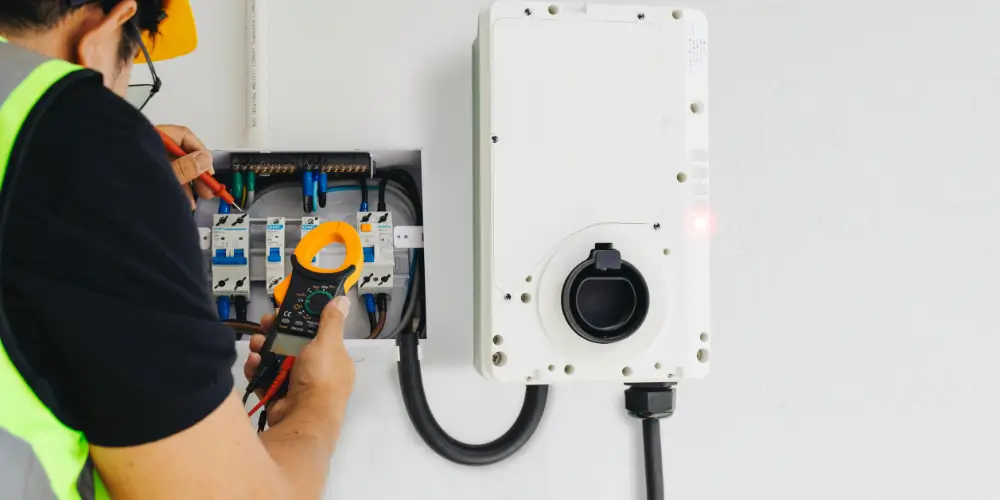
Although every installation is unique, we follow a structured BS 7671 and GN3 workflow to verify bathroom circuits lacking RCDs: confirm supply characteristics and safe isolation; identify the circuit arrangement against drawings; visually inspect IP ratings, zoning compliance, and bonding; then perform instrument tests in sequence R1+R2 or Zs continuity, insulation resistance with appropriate segregation of sensitive equipment, polarity, and prospective fault/short‑circuit currents (PEFC/PSCC).
| Step | Purpose |
| Safe isolation | Protect occupants and operatives |
| Continuity/Zs | Confirm disconnection times feasibility |
| Insulation resistance | Detect moisture‑related degradation |
We document test values, compare against BS 7671 limits, and note departures. Our testing procedures also include verifying CPC continuity to all exposed‑conductive‑parts and confirming main and supplementary bonding integrity. Where Zs margins are tight without RCDs, we calculate adiabatic compliance, assess breaker characteristics, and record risk. Verification methods extend to functional checks of bathroom equipment and labels. Electrician responsibilities: keep calibrated instruments, apply correct test voltages, and reinstate circuits safely.
Remedies at the Consumer Unit: RCDs, RCBOs, and SPDs
When bathroom circuits lack RCD protection, we prioritise corrective measures at the consumer unit that align with BS 7671: install RCD protection via dual‑RCD boards or, preferably, circuit‑specific RCBOs to achieve 30 mA additional protection and compliant disconnection times. We assess spare ways, earthing, maximum Zs, and enclosure ratings before specifying RCD installation options. RCBO advantages include isolating faults per circuit, reducing nuisance trips, and simplifying fault-finding. We also recommend Surge Protective Devices to protect sensitive electronics and mitigate transient overvoltages SPD benefits extend equipment life and reduce shock and fire risks. All works require dead testing, live verification, and labelling updates, with certification reflecting the altered protective devices.
- Dual‑RCD board upgrade or RCBO retrofit assessment
- Selection of Type A devices for modern loads
- Coordination with upstream RCDs and bonding checks
- SPD Type 2 selection and correct earthing routes
Targeted Upgrades: Local RCD Spurs and Isolation Options
Where a board upgrade isn’t viable in the short term, we can achieve BS 7671 additional protection locally by fitting RCD FCU spurs or RCD sockets to bathroom‑adjacent circuits serving lights, fans, or shaver outlets. These local RCD solutions must be 30 mA with ≤40 ms disconnection at 5x IΔn and verified by testing. We’ll select components with adequate IP ratings for zones and maintain CPC continuity, polarity, and Zs within device limits.
We’ll provide bathroom isolation by adding clearly labelled double‑pole isolation outside zones, or an RCD FCU supplying the fan via a 3‑pole isolator. We’ll avoid exporting unprotected line conductors into zones. Safety upgrades include segregating SELV where used, confirming bonding to 701.415.2, and recording circuit labelling and test results.
Cost, Disruption, and Prioritising Repairs for Compliance
Even before we pick up tools, we’ll scope costs, downtime, and sequencing so the installation reaches BS 7671 compliance with minimal disruption. We map hazards first bathroom circuits without RCDs get top compliance priorities because shock risk is acute. Then we balance cost implications against future-proofing: a local RCBO spur may be quicker today, but a consumer unit upgrade can reduce downstream remedials.
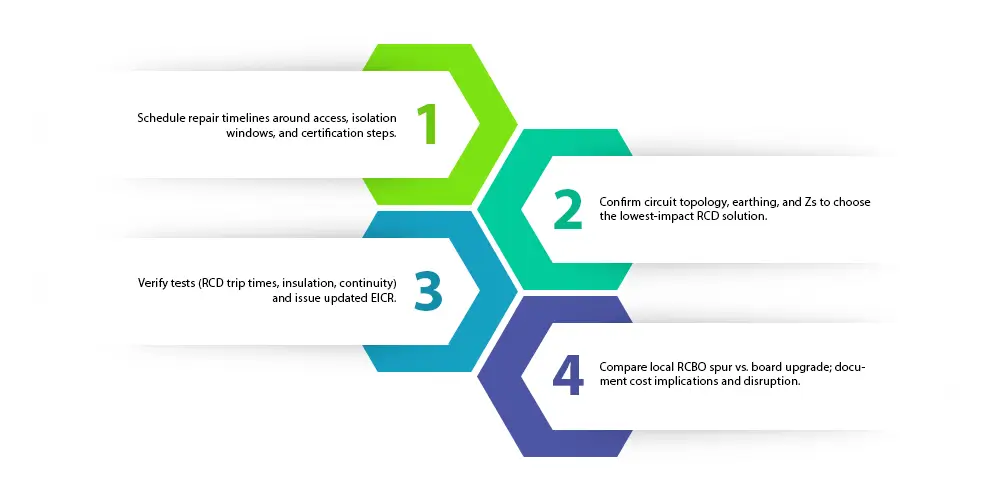
We’ll sequence works to maintain safety, minimise rework, and close C2 items promptly, keeping records audit-ready.
Frequently Asked Questions
Can Smart Bathroom Mirrors or Demisters Affect RCD Selection or Coding?
Yes. We’d assess smart mirror safety and demister compliance against bathroom zones; SELV/isolated supplies can alter RCD choice, but most require 30 mA RCD protection. If absent or unsuitable, we’d code accordingly and recommend electrical upgrades for risk reduction.
How Do Vintage or Period Bathrooms Influence RCD Retrofit Approaches?
They push us toward sensitive retrofits: we assess vintage wiring, hidden junctions, and design constraints, then specify RCD/RCBO placement, separation, or sub-circuits to meet safety standards while preserving fabric, managing isolation, earth continuity, bonding, enclosure IP ratings, and documentation.
Are Temporary Portable RCD Adapters Acceptable During Renovation Phases?
Yes, they’re acceptable as interim protection. We’d use them under temporary RCD safety principles, follow portable RCD guidelines, test before use, document limitations, and guarantee compliance with renovation electrical standards, while planning prompt installation of permanent, circuit-level RCD protection.
What Documentation Should Homeowners Request After RCD Upgrade Works?
Request an Electrical Installation Certificate, test results, updated circuit schedules, RCD trip-time records, and Part P/Building Regulations notification. We emphasize EICR certification importance, homeowner responsibilities, and retaining electrical compliance documentation for warranties, insurance, future inspections, and traceability against current standards and risks.
How Do EV Chargers or PV Systems Interact With Bathroom Circuit RCDS?
They can share upstream RCDs, but we design discrimination. We guarantee EV Charger Compatibility and PV System Safety using Type A/F/B devices, dedicated RCBOs, and SPD/AFDD where required, preventing nuisance trips and maintaining bathroom RCD Circuit Design selectivity per standards.
Conclusion
In conclusion, if an EICR flags no RCD protection in a bathroom, we should treat it as a safety priority. BS 7671 requires 30 mA RCDs for circuits serving locations containing a bath or shower. We’ll assess whether a C2 or C3 applies, verify tests, and recommend proportionate fixes—typically RCBOs or RCD protection at the board, with local RCD spurs only as interim measures. Addressing this reduces shock risk, improves compliance, and future‑proofs the installation.