In London, we PAT test portable, movable, and stationary plug-in appliances, plus detachable leads; fixed hard‑wired devices fall under EICR. We set risk-based intervals aligned to BS 7671 and the IET Code: offices typically 12 months for Class I, 24 months for Class II; kitchens ~6 months; retail 6–12 months; construction tools every 3 months. We tailor tests to environment and equipment class, document results with asset IDs, and provide tamper‑evident reports next, we outline how to build a cost‑effective schedule.
Key Takeaways
- Test all landlord/business-supplied plug-in appliances and detachable leads; exclude hard-wired fixed installations (covered by EICR, not PAT).
- Prioritise by risk: kitchens, construction tools, portable heaters, and high-use items need tighter cycles than low-use office equipment.
- Typical frequencies: office Class I annually; Class II every 24 months; kitchens 6 months; construction site tools every 3 months.
- Record asset ID, make/model/serial, location, test method/results; keep tamper-evident reports and calibration certificates for compliance.
- Use competent, insured, UKAS-traceable testers; avoid over-testing sensitive equipment and ensure visual checks between tenancies.
Table of Contents
Understanding PAT Testing in London’s Regulatory Landscape
Three frameworks shape how we approach Portable Appliance Testing (PAT) in London: statute, regulation, and guidance. We map duties from the Health and Safety at Work etc. Act, the Electricity at Work Regulations, and applicable British Standards to define regulatory compliance. These instruments don’t prescribe fixed intervals; they require risk-based controls aligned with safety standards such as BS 7671 and the IET Code of Practice. We translate that into testing procedures proportionate to environment, usage, and equipment construction.
We document inspection scopes, specify earth continuity, insulation resistance, polarity, and functional checks, and set retest periods from risk assessments. We guarantee competent persons, calibrated instruments, and traceable records. We brief dutyholders on remedial actions, isolation protocols, and evidence retention to withstand audits and demonstrate defensible compliance.
Which Appliances Count as Portable, Movable, or Fixed
While legislation doesn’t define categories exhaustively, we classify appliances pragmatically to set inspection scope and tests. We distinguish portable appliances, movable equipment, and fixed installations by connection method, mass, and means of isolation. Portable units plug in and are easily carried; movable items are plug‑connected but heavier or on castors; fixed installations are hard‑wired or permanently secured. This informs insulation, earth continuity, and polarity checks, and whether isolation and lock‑off are required.
We classify by connection, mass, and isolation to define inspection scope and tests.
- Portable appliances: kettles, laptops, desk fans; IEC lead-detachable; visual plus PAT with Class I/II differentiation.
- Movable equipment: fridges, floor scrubbers; plug-fed yet repositioned; earth bond at higher test current.
- Stationary equipment: heavy, set in place; plug-connected but not routinely moved.
- Fixed installations: hard-wired heaters, hand dryers; inspected via EICR, not PAT.
- Connection accessories: extension reels and IEC leads tested as separate items.
Environments That Require Different Testing Approaches
Having set the scope by appliance type and connection method, we now match test methods to the environment in which equipment operates. We adapt testing methodologies to construction sites, offices, healthcare, education, hospitality, retail, and industrial plants because duty cycles, contaminants, and user profiles differ. We align procedures with industry standards and our prior equipment classification.
In dry offices, we prioritise insulation resistance, polarity, and earth continuity on Class I/II IT and kitchen ancillaries. In healthcare-adjacent areas, we use reduced test currents and leakage measurements compatible with sensitive devices. On construction sites, we emphasise robust earth bond testing, IP-rated visual inspection, and RCD verification. In kitchens and hospitality, we inspect heat, moisture, and ingress routes and verify cord anchorage. In workshops, we add functional load tests on high-inrush or three-phase tools.

Risk Assessment: Factors That Set Testing Frequency
Before we set intervals, we quantify risk. We model testing frequency factors using evidence: equipment construction, fault history, usage intensity, and environment. Our risk assessment criteria consider likelihood of damage, severity of failure, and detectability between inspections. We align outcomes with compliance requirements so schedules withstand audits and protect users.
- Asset profile: class, insulation type, IP rating, earthing method, and mobility drive baseline intervals.
- Environmental stressors: moisture, dust, vibration, temperature cycling, and chemical exposure elevate frequency.
- Usage regime: duty cycle, user population, handling practices, and movement between sites increase wear.
- Maintenance maturity: documented inspections, defect closure rates, and spare-part quality reduce residual risk.
- Incident data: test failures, RCD trips, and near-miss reports calibrate interval adjustments.
We document rationale, assign owners, and review after significant change or adverse findings.
Offices and Corporate Workspaces: What to Test and When
Our risk model now guides what we test in offices and how often. We classify office equipment by construction class, usage, and environment. Class I items with detachable leads desktops, monitors, kettles, shredders require earth continuity, insulation, and polarity checks; leads are tested separately. Class II devices phone chargers, some printers receive insulation and functional checks. Portable heaters and kitchen appliances carry higher risk.
We set testing frequency accordingly: every 12 months for Class I in general offices, 24 months for low-risk Class II, and 6 months for high-use communal appliances. Server racks and UPS units undergo visual inspections quarterly and electrical tests annually, coordinated to minimize downtime. We document results to demonstrate safety compliance, trend faults, and trigger remedial actions or asset withdrawal.
Retail, Hospitality, and Public Spaces: Practical Schedules
Although customer-facing environments vary widely, we anchor PAT schedules in risk: equipment class, plug/lead condition, user interaction, and exposure to heat, moisture, or movement. In shops, cafés, bars, hotels, and museums, we tier intervals to protect public safety while minimising disruption. High-handling retail equipment (barcode scanners, card terminals, display lighting) warrants 6–12 month inspections; back-of-house kit can extend to 12–24 months if history and environment are stable. Kitchens demand tighter cycles aligned with hospitality standards grease, steam, and frequent cleaning accelerate degradation. We document results, isolate defects immediately, and tag assets for traceability.
- Front-of-house Class I appliances: 6–12 months.
- Kitchen and bar appliances: 6 months.
- Portable chargers and loaner leads: 3–6 months.
- Fixed display lighting: 12 months.
- Cleaning machines and extension reels: 6–12 months.
Construction Sites and Industrial Settings: High-Risk Protocols
Even in the most disciplined projects, construction and industrial environments elevate electrical risk through vibration, impact, dust, moisture, and constant relocation of equipment. In these high risk environments, we tighten safety protocols and shorten test intervals. We PAT test 110V tools, 230V equipment, site transformers, RCDs, extension leads, and portable lighting. We inspect enclosures, strain reliefs, IP ratings, and guards, then verify earth continuity, insulation resistance, polarity, and RCD trip times.
We recommend formal visual checks before each shift, user checks daily, combined inspection and testing every three months for portable tools, and monthly RCD testing. After repairs or drops, we retest immediately. We log serials, locations, and defects to drive equipment maintenance. Where plant is hard-wired, we coordinate fixed testing and lockout/tagout to maintain continuity and compliance.
Landlords and Letting Agents: Duties for Rented Properties
Because rented homes must remain safe throughout a tenancy, landlords and letting agents have defined duties for electrical maintenance, inspection, and record‑keeping. We apply landlord responsibilities to all supplied appliances and fixed equipment within scope of the tenancy. We verify conformance to safety standards, document defect remediation, and schedule retests proportionate to risk and usage. We brief tenants on safe use and swift fault reporting, protecting tenant rights and minimizing downtime. We coordinate access, isolate hazards, and remove failed items from service immediately.
- Define appliance scope: landlord‑supplied only; note exclusions.
- Set inspection intervals by risk (kitchen, portable heaters, HMOs).
- Conduct formal visual checks between tenancies.
- Instruct tenants on safe use and escalation pathways.
- Decommission, repair, or replace equipment failing safety standards.
Record Keeping, Labelling, and Evidence for Insurers
When we test appliances, we create a defensible audit trail that satisfies insurers and regulators. We assign a unique asset ID, capture make, model, serial number, location, test method, instrument calibration reference, results, remedial action, and technician signature. Labels show pass/fail status, retest date, and asset ID, linking the item to the digital record.
We maintain compliance audit trails with tamper-evident PDFs and time-stamped logs. Our record retention strategies align with insurer and statutory expectations: typically five to six years, or longer for high-risk environments. We store certificates, risk assessments, calibration certificates, and fault rectification evidence together. Because of insurance documentation importance, we supply traceable reports on demand, demonstrating control measures, defect closure, and change history evidence that withstands claims scrutiny and external audits.
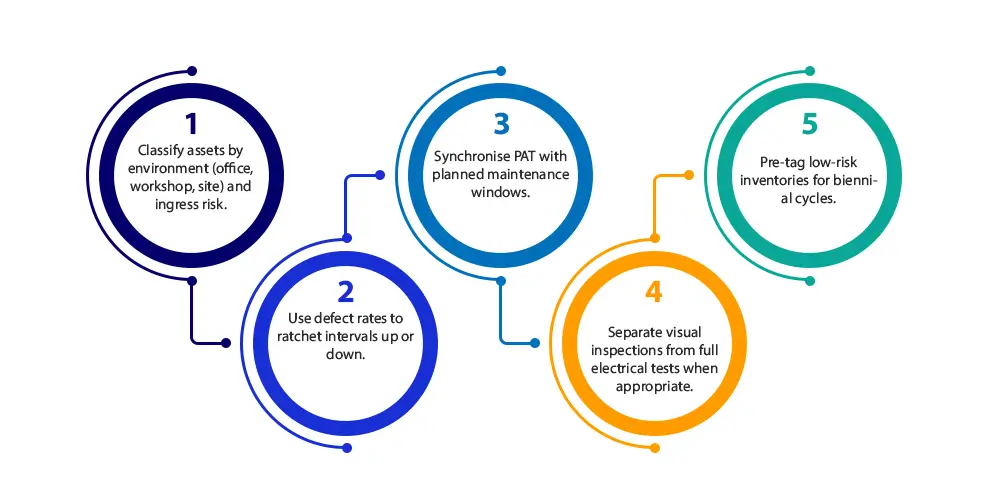
Creating a Cost-Effective Testing Schedule
Although safety remains non‑negotiable, we build cost‑effective PAT schedules by risk profiling every asset and matching test frequencies to actual exposure. We align testing frequency with environment, class of equipment, duty cycle, and fault history, then sequence visits to minimise downtime and call‑outs. Our cost effective strategies prioritise high‑risk circuits while extending intervals on demonstrated low‑risk items, always evidencing decisions in records that satisfy insurers and auditors. Budget considerations drive bundling by location and voltage class to reduce travel and setup.
Common Pitfalls: Over-Testing, Under-Testing, and Missed Items
Our risk‑based schedules only work if we avoid three common traps: over‑testing, under‑testing, and missed items. Over‑testing inflates cost, introduces avoidable downtime, and increases damage risk to sensitive gear classic over testing consequences. Under‑testing lets insulation degradation, faulty earth continuity, or damaged cords persist serious under testing risks. Missed items occur when we exclude detachable leads, loaned equipment, or infrequently used tools preventable through rigorous missed appliance identification.
| Pitfall | Control Measure |
| Over‑testing | Align intervals to environment, usage, and Class; justify with defect trend data. |
| Under‑testing | Escalate frequency after failures; validate with spot checks and periodic audits. |
| Missed items | Asset-register reconciliation; barcode every appliance and lead. |
| Data gaps | Record serials, locations, test methods, and results; review for anomalies. |
We should verify scope before each round, sample high-risk circuits, and update intervals using evidence.
Choosing a Competent PAT Tester in London
Because competence drives both safety and value, we should select a London PAT provider that demonstrates clear technical capability, documented processes, and verifiable results. We prioritise certification verification, ensuring engineers hold current City & Guilds, NVQ, or equivalent, and that calibration certificates for instruments are in date. We conduct experience evaluation by sector offices, hospitality, healthcare so test methods align with risk profiles and duty cycles. We also examine reporting outputs: asset registers, risk ratings, and rectification notes must be complete and time-stamped. Finally, we review liability cover, data security, and response SLAs.
- Confirm accreditation and insurance limits
- Validate meter calibration traceability to UKAS
- Map experience to our equipment categories
- Sample reports for clarity and defect coding
- Triangulate customer reviews with references
Frequently Asked Questions
Do Remote Workers’ Home Office Devices Require Employer-Arranged PAT Testing?
Yes—when we provide equipment, we’re responsible for device safety. For remote work, employer responsibilities include risk assessment, inspection, and testing company-owned devices. Employee-owned devices require guidance, self-checks, and documented verification to guarantee safe use and compliance with relevant electrical safety regulations.
How Should Startups Handle PAT During Rapid Office Moves or Expansions?
We prioritize a rolling PAT approach: integrate office relocation strategies with rigorous equipment inventory management, tag assets per site, and maintain testing schedule flexibility. We coordinate certified testers pre-move, validate high-risk items first, and document continuity for compliance and insurance.
Are EV Chargers and E-Bike Chargers Included in PAT Testing Scope?
Yes—portable EV chargers and e-bike chargers fall within PAT scope; fixed EVSEs need electrical inspection, not PAT. We’ll verify EV charger compliance, assess E bike safety, and set testing frequency based on risk, use environment, and manufacturer guidance.
What Languages Can PAT Labels and Reports Be Issued in for Multinational Teams?
We can issue PAT labels and reports in any required languages. We support multilingual documentation to meet international compliance, incorporating cultural considerations, regional terminology, and character sets. Specify languages; we’ll standardize translations, formatting, and test references across sites.
How Do You Coordinate PAT Testing Without Disrupting 24/7 Operations?
We coordinate PAT testing by deploying scheduling flexibility, equipment prioritization, and after hours testing. We map critical loads, segment circuits, shadow maintenance windows, use hot-swap spares, and stage test rigs. We communicate, batch test, and document results in real time.
Conclusion
We’ve covered what London’s regulations expect, which items qualify for PAT, and how environment and risk drive frequency. Prioritise high-risk appliances, document inspections, and align intervals with usage, location, and manufacturer guidance. Keep clear asset registers, labels, and reports to satisfy insurers and auditors. Avoid blanket annual testing; target resources using risk assessment. Select a competent, City-savvy tester with calibrated instruments and traceable methods. With a tailored schedule, we’ll stay compliant, reduce downtime, and control costs.