
When tenants complain about your contractors, property managers should acknowledge promptly, log details, and assess severity. They gather evidence such as photos, work orders, schedules, and statements. Communication sets expectations, timelines, and a single point of contact. Safety, access control, and cleanup are enforced. Performance is measured against SLAs, with corrective action, rework, credits, or refunds as needed. Standardized work orders, sign-offs, and surveys confirm closure. Metrics and vendor scorecards prevent repeat issues. Next comes a practical framework and tools.
Key Takeaways
- Acknowledge the complaint immediately, log details, assess severity, and communicate next steps with clear timelines and responsible parties.
- Gather evidence: timestamped photos, work orders, access logs, and tenant statements; obtain third-party assessments if technical disputes arise.
- Address contractor performance via SLAs: evaluate punctuality, workmanship, and communication; require corrective action plans and escalate repeat issues.
- Enforce safety and access controls: verified IDs, scheduled entry, PPE, containment, no-go rooms, cleanup, and incident logging to protect tenants.
- Tighten vendor agreements: clear scopes, milestones, quality criteria, change-control procedures, and post-service tenant sign-offs with feedback loops.
Table of Contents
Recognizing the Most Common Contractor Complaints
Why do certain contractor issues surface repeatedly across tenant complaints? Patterns emerge around punctuality lapses, unclear scopes of work, and inconsistent communication. Tenants cite missed appointments, prolonged disruptions, and debris left behind. They also report workmanship defects improper installations, incomplete repairs, or quick fixes that fail under normal use. Safety oversights, such as unsecured areas or blocked egress, erode trust. Billing ambiguities unexpected add-ons or vague change orders create friction.
A systematic lens links these issues to gaps in contractor professionalism: weak protocols for scheduling, site etiquette, documentation, and quality control. Property managers can map complaints to root causes, set measurable standards, and align incentives with tenant satisfaction. Clear SLAs, documented checklists, photo verification, and post-visit summaries reinforce accountability and foster a community experience tenants value.
Immediate Steps to Take When a Complaint Comes In
When a complaint is received, the manager should acknowledge it promptly and record all relevant details in a centralized log. They then assess severity using defined criteria such as safety risk, service disruption, and contractual impact to determine priority and response time. Finally, they communicate next steps with clear timelines, responsible parties, and follow-up checkpoints to guarantee accountability and resolution.
Acknowledge and Document
Start by promptly acknowledging every complaint to confirm receipt and set expectations. A brief, time-stamped response builds trust and signals that tenant feedback matters. Next, document precisely: who reported, what happened, where, when, and any related contractor reviews. Centralize records in the property management system, attaching emails, photos, call logs, and work orders. Keep language neutral and factual to support fair follow-through and consistent standards across the community.
- Create a standard acknowledgment template that includes response timelines, a case ID, and contact details.
- Log evidence immediately screenshots, messages, and audio notes then back up files to a secure, searchable repository.
- Track communication milestones and responsibilities so tenants know who is acting and when.
Thorough acknowledgment and documentation foster belonging and accelerate resolution.
Assess Issue Severity
With the complaint acknowledged and documented, the next step is to quickly assess severity to determine risk, response speed, and escalation path. A structured severity assessment considers safety, habitability, asset protection, regulatory exposure, and vulnerability of affected tenants. Evidence is verified: photos, timestamps, contractor scope, and any service disruptions. Health and safety hazards, water intrusion, electrical risks, or access failures receive highest issue prioritization. Moderate issues include workmanship defects impacting comfort or timelines. Low severity covers inconveniences without risk or damage.
Use a triage matrix with defined thresholds, SLAs, and owner approvals to prevent bias. Cross-check lease obligations and building codes to calibrate urgency. Document the severity rating, rationale, and required actions so teams align quickly, protect residents’ dignity, and safeguard property outcomes.
Communicate Next Steps
Clarify next steps immediately to set expectations and maintain momentum. A property manager should confirm receipt, outline the plan, and define who will act and when. This anchors tenant expectations and reinforces consistent contractor communication. Provide time frames, access needs, and the escalation path if timelines slip. Use concise updates, preferably written, to preserve accountability and inclusion.
- Define scope and ownership: identify the issue, assign a responsible party, and share contact details for updates.
- Set timelines: communicate inspection, repair, and follow-up dates, plus contingencies for parts, permits, or safety checks.
- Close the loop: after work, confirm completion, solicit feedback, and document outcomes.
Maintain a single communication thread, summarize decisions after calls, and flag any policy or warranty constraints upfront to prevent confusion and rebuild trust.
Gathering Facts: Documentation and Evidence
Effective resolution begins with a clear factual record built from contemporaneous documentation. A disciplined fact gathering process anchors impartial decisions, supports community trust, and protects all parties. Evidence collection should include timestamped photos, work orders, contractor schedules, access logs, and tenant statements captured verbatim. Cross-referencing these items exposes gaps and patterns without speculation.
| Artifact | Purpose |
| Time-stamped photos/videos | Verify condition before/after work |
| Work orders and change logs | Track scope, approvals, and deviations |
| Contractor entry/exit records | Confirm presence and duration |
| Tenant statements (dated) | Preserve firsthand observations |
Retention matters: store materials in a centralized repository with version control and immutable timestamps. Label items consistently (date-location-issue). Corroborate claims by aligning artifacts on a shared timeline. When uncertainty persists, obtain third-party assessments to validate technical assertions.
Communicating With Tenants Professionally and Promptly
Prioritize timely, transparent contact to reduce escalation and build credibility. Professional communication acknowledges concerns, explains next steps, and sets realistic timelines. Clear, respectful tone signals accountability and fosters tenant satisfaction, especially when emotions run high. Consistency across channels email, phone, portals ensures nothing is missed and creates a documented thread for reference.
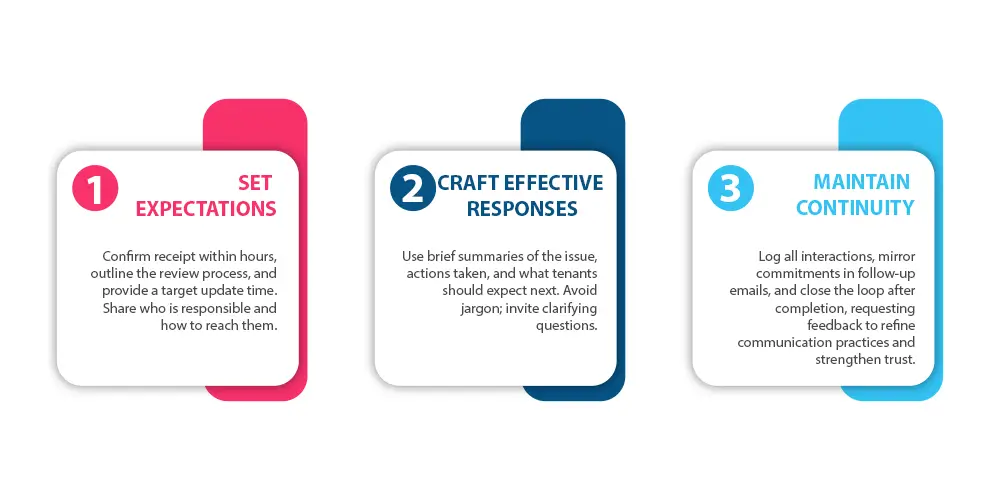
Timely, transparent communication builds credibility, reduces escalation, and fosters tenant trust across every channel.
Addressing Contractor Performance and Conduct Issues
Resolve contractor issues with a structured, evidence-based approach that protects service quality and tenant experience. Management should document each complaint, verify facts with timestamps, photos, and work orders, and compare findings against service-level agreements. Consistent contractor evaluations covering punctuality, workmanship, communication, and adherence to scope create clear benchmarks. Share aggregated trends with vendors and set corrective action plans with deadlines, training requirements, and measurable outcomes.
When conduct problems emerge, use a tiered response: verbal notice, written warning, probation with enhanced oversight, and, if required, removal from the roster. Close the loop with tenants by confirming resolution and measuring tenant satisfaction through brief surveys. Maintain a preferred-vendor matrix that rewards reliable partners and suspends repeat offenders, reinforcing a culture of accountability and shared standards.
Safety, Privacy, and Access Protocols for Occupied Units
Clear protocols for safety, privacy, and access in occupied units reduce risk, protect tenant rights, and guarantee uninterrupted operations. A disciplined framework signals respect for residents and clarifies contractor responsibilities. It also prevents avoidable conflict by standardizing how people, tools, and information enter the living space.
- Access control: Require verified IDs, time-stamped entries, and escort procedures; limit entry to scheduled windows with advance notice compliant with tenant rights.
- Privacy safeguards: Define no-go rooms when possible, prohibit photography except for documented repairs, and secure resident data; use door signage and on-site consent confirmations.
- Safety standards: Enforce PPE, containment barriers, and daily cleanup; isolate hazards, test alarms after work, and log incidents.
Document deviations immediately, communicate closures or delays, and provide a single point of contact to restore trust swiftly.
Setting Clear Expectations in Vendor Agreements
Clear vendor agreements reduce disputes by defining scope and deliverables with measurable outputs and responsible parties. Timelines and milestones should be specific, sequenced, and supported by reporting requirements and remedies for slippage. Quality and compliance must reference standards, inspection procedures, and corrective actions to guarantee work meets regulatory and contractual obligations.
Scope and Deliverables
A well-defined scope and deliverables section anchors vendor agreements by translating operational needs into measurable obligations. It clarifies what is included, what is excluded, and how work will be evaluated, creating shared understanding that protects tenant experience and ownership standards. Clear descriptions of contractor responsibilities and acceptance criteria reduce ambiguity, while procedures for scope adjustments guarantee changes are documented, priced, and approved before work proceeds.
- Define deliverables precisely: materials, methods, service levels, and quality benchmarks, with objective acceptance tests and documentation requirements.
- Specify interfaces: site access rules, tenant communication protocols, cleanup duties, safety practices, and who supplies permits, utilities, and waste handling.
- Establish change control: triggers, approval authority, pricing mechanisms, and recordkeeping to manage scope adjustments without eroding accountability.
Result: fewer complaints, smoother collaboration, and predictable outcomes.
Timelines and Milestones
Discipline in scheduling converts expectations into accountable performance by defining when each activity starts, finishes, and is verified. Clear timelines and milestones give property teams and residents a shared map, reducing uncertainty and diffusing frustration when work affects daily life. Agreements should include a baseline schedule, milestone dates, and dependencies tied to access, permits, and material lead times. Contractor scheduling must specify working hours, tenant notifications, and escalation points if slippage emerges. A progress reporting cadence weekly updates with percentage complete and look-ahead tasks enables early detection of project delays. Contracts should require recovery plans when milestones drift, including resource reallocation or resequencing. Time-based incentives and measured liquidated damages align performance with community expectations, ensuring accountability without sacrificing collaboration and trust.
Quality and Compliance
Few elements reduce complaints more reliably than rigorous quality and compliance criteria embedded in vendor agreements. A property team fosters trust when contractor standards are explicit, measurable, and auditable. Clear benchmarks for service quality, safety, and documentation help every stakeholder know what good performance looks like and how it will be verified.
- Define scope and tolerances: specify materials, workmanship tolerances, response times, cleanup, and tenant communication protocols, with acceptance criteria and hold-points.
- Codify compliance: require licenses, insurance, OSHA adherence, background checks where applicable, and proof-of-work artifacts (photos, permits, sign-offs).
- Enforce accountability: link milestones to inspections, include corrective-action SLAs, retainage, and performance scorecards that influence future work.
Routine audits, tenant feedback loops, and transparent incident resolution reinforce shared expectations, elevate service quality, and reduce recurring complaints.
Vetting and Screening Contractors Before They’re Hired
Thorough vetting of contractors before engagement reduces project risk, protects tenants, and safeguards budgets. Effective screening starts with clear contractor qualifications aligned to scope, verified licensing standards, and documented insurance requirements. Property teams conduct background checks, reference verification, and reputation assessment to confirm integrity and reliability. Structured contractor interviews explore performance history, safety culture, service guarantees, and pricing transparency to guarantee fit with community expectations and fair value.
| Focus Area | What to Confirm |
| Licensing Standards | Active licenses match trade and jurisdiction |
| Insurance Requirements | Current COIs, adequate limits, endorsements |
| Performance History | On-time delivery, rework rates, safety record |
| Pricing Transparency | Detailed estimates, change-order logic, markups |

Establishing a Standardized Work Order and Follow-Up Process
A standardized work order process starts with clear criteria that define scope, priority, and required documentation. Timelines, milestones, and named points of accountability guarantee requests move predictably from intake to completion. Post-service confirmation steps such as tenant sign-off, photo verification, and performance feedback close the loop and prevent recurring complaints.
Clear Work Order Criteria
Why do tenant and contractor complaints persist despite good intentions? Often, vague requests and uneven expectations derail otherwise capable teams. Clear work order criteria align everyone around the same facts. Standardized work order templates and concise contractor guidelines define scope, materials, access requirements, photos, and safety constraints so no one feels left out of the loop.
- Scope definition: Specify problem statements, locations, exclusions, and required materials; attach photos and serial numbers to reduce misdiagnosis.
- Site readiness and access: Document entry permissions, pet notes, noise sensitivities, and contact hierarchy to respect tenant needs and avoid repeat visits.
- Quality acceptance criteria: State completion standards, before/after photos, cleanup expectations, and sign-off steps to validate results.
When criteria are uniform, teams collaborate smoothly, tenants feel heard, and contractors deliver consistent, verifiable outcomes.
Timelines and Accountability
With clear criteria in place, performance hinges on predictable timelines and ownership at every step. A standardized work order sets target response, dispatch, and completion windows, paired with timely updates at each milestone. Owners define who approves, who executes, and who communicates, so nothing drifts. Accountability measures include timestamped logs, SLA thresholds, and escalation paths that trigger when targets slip. This structure reinforces belonging: everyone knows their role and how success is recognized.
| Phase | Deadline | Emotional Cue |
| Acknowledge | 2 hours | “We hear you.” |
| Triage | 8 hours | “You matter.” |
| Dispatch | 24 hours | “Help is moving.” |
| Repair | 72 hours | “We’ve got you.” |
| Review | 96 hours | “We stand together.” |
Dashboards track variance, enabling coaching, contractor scoring, and continuous improvement.
Post-Service Confirmation Steps
How does a service request truly reach closure? It closes when documentation, confirmation, and communication align. A standardized work order captures scope, photos, materials, time-on-site, and sign-off from both contractor and tenant. After completion, management validates outcomes against the original request, ensuring no residual issues. Post service surveys then gather tenant feedback to confirm satisfaction and surface gaps.
- Define completion: require before/after photos, checklist compliance, and digital signatures; link all artifacts to the work order for auditability.
- Verify resolution: perform a 24–48 hour follow-up call or text, confirm functionality, and note any recurrence triggers for rapid return.
- Learn and improve: analyze tenant feedback, score contractors on responsiveness and quality, and adjust approved vendor status, SLAs, and training.
Remediation, Refunds, and Make-Good Strategies
Effective remediation, refunds, and make-good strategies hinge on timely assessment, clear accountability, and proportional remedies aligned to the impact of the issue. A structured intake documents the complaint, clarifies tenant expectations, and verifies scope against work orders. Contractor accountability is established through written findings, photos, and time-stamped logs. Remedies should escalate by severity: immediate rework with priority scheduling; partial credits for inconvenience or minor defects; full refunds when work is unusable; and temporary accommodations when habitability is impaired. Provide a single point of contact, a written offer with timelines, and consent-based scheduling. Confirm completion with tenant sign-off and itemized credits on the ledger. Where appropriate, extend warranties, waive fees, or provide goodwill gestures that demonstrate respect and reinforce community trust.
Tracking Metrics and Feedback to Prevent Repeat Issues
Although each complaint is unique, preventing repeat issues requires a disciplined system for measuring, analyzing, and acting on performance data. A property team can standardize intake, categorize root causes, and align repairs to clear service levels. Consistent tracking supports tenant satisfaction by signaling that every voice matters and every pattern is addressed.
Standardize intake, track root causes, and act on data to prevent repeat issues and build trust.
- Define metrics: response and resolution time, first-visit fix rate, callback frequency, cleanliness scores, and safety compliance.
- Establish feedback loops: brief post-service surveys, photo verification, and timestamped notes tied to work orders for continuous contractor evaluation.
- Analyze and act: monthly trend reviews, exception reports, and corrective action plans with deadlines.
Dashboards should flag outliers and surface wins to celebrate. Documented insights guide training, scope refinements, and communication templates that prevent repeat friction.
Building a Preferred Vendor List and Accountability System
When a property team curates a preferred vendor list, the goal is to align contractors with clear standards for quality, speed, safety, and cost control. The framework begins with prequalification, service-level agreements, and transparent scorecards that reinforce quality assurance and protect the vendor relationship. A simple accountability system tracks response times, first-pass completion rates, tenant satisfaction, and safety compliance.
| Element | Practice |
| Prequalification | Licenses verified, insurance current |
| Service Scope | Defined deliverables, escalation paths |
| Performance Metrics | Response time, completion rate, callbacks |
| Review Cadence | Quarterly scorecards, corrective plans |
Disputes route through documented protocols, ensuring fairness and timely resolution. Vendors receive targeted feedback and coaching; persistent gaps trigger probation or rotation. Tenants see faster resolutions, consistent behavior on-site, and clear communication, reinforcing trust in the property’s standards.
Frequently Asked Questions
How Should I Handle Contractor Complaints During an Eviction or Holdover Situation?
They should document complaints, pause nonessential work, and communicate neutrally. Prioritize tenant rights, enforce contractor accountability, and follow lease and local law. Offer clear timelines, designate a liaison, propose corrective actions, and escalate serious issues through written notices, insurance, or regulatory channels.
What if the Contractor Is a Relative or Friend of the Landlord?
They should disclose the relationship, avoid contractor favoritism, and use neutral procurement and oversight. Independent inspections, clear service standards, and responsive communication address tenant perceptions, preserve fairness, and document compliance, reducing conflict risk during sensitive proceedings while supporting a respectful, inclusive living environment.
Can Tenants Record Contractor Visits for Evidence Without Consent?
Yes whether tenants may record depends on jurisdiction. Tenant rights intersect with recording laws: one-party consent often permits recording in their home; all-party consent may restrict audio. They should review leases, post notices, prioritize safety, and seek community or legal guidance.
How Do Complaints Affect Insurance Claims or Premiums?
Complaints can trigger insurance implications by signaling increased risk, potentially prompting investigations, claim scrutiny, and premium adjustments. Documented remediation, contractor vetting, and swift resolution reduce exposure, support favorable underwriting, and preserve community trust, possibly preventing surcharges, deductibles increases, or coverage limitations at renewal.
What Are Timelines for Addressing Complaints During Holidays or Emergencies?
Timelines prioritize same-day triage under emergency protocols and 24–48 hour follow-up; non-urgent issues receive responses within 2–3 business days. During holidays, holiday responsiveness maintains on-call coverage, documented updates, and escalation paths, ensuring coordinated communication, accountability, and community-centered resolution.
Conclusion
A disciplined response to contractor complaints protects tenant satisfaction, property value, and operational efficiency. By recognizing common issues, triaging promptly, documenting thoroughly, and communicating professionally, managers demonstrate accountability and control. Addressing contractor conduct, standardizing work orders, and implementing transparent follow-up closes service gaps. Remediation and fair refunds rebuild trust, while tracking metrics exposes patterns and informs vendor coaching or replacement. Over time, a curated preferred vendor list and clear accountability system reduce friction, accelerate resolution, and elevate service consistency.